01 · Question
An absolute existence question
NGC 4700 is a highly inclined (b/a=0.19) starburst galaxy whose Hα+[N II] imaging (Rossa et al. 2008) shows extended extraplanar ionized-gas structure. The question is simple: within a frozen minor-axis sector, does a measurable 0.5–2.0 keV diffuse soft X-ray component exist whose surface brightness exceeds a pre-declared background model?
This is not the parent I122's question. I122 measures the differential contrast Delta_S = S_minor − C_lateral, which is naturally immune to any background term present in both the signal and control apertures. R4's two-world D051 anchor proves: (S,C)=(1+0, 2+0) and (S,C)=(1+1, 2+1) give the same Delta_S = −1, while the hot-phase existence flips from false to true. I177 asks for the absolute quantity Sigma_S − B, where B is a frozen, detector-qualified background model (QPB + CXB + SWCX + residual soft protons).
02 · Why it matters
Is the warm–hot correspondence universal?
Whether the extraplanar warm ionized structure (Hα+[N II]) of edge-on starburst galaxies is always accompanied by a hot X-ray phase is a foundational assumption of disk–halo mass and energy recycling models. Rossa et al. (2008) saw filamentary eDIG morphology in NGC 4700, but no published X-ray measurement confirms or denies its hot counterpart. Li et al. (2013)'s 53-galaxy Chandra sample does not include NGC 4700.
If PRESENT: the warm–hot correspondence gains a quantitative anchor in a system that already has warm-phase imaging. If BOUNDED ABSENT: a deep XMM field (PN 77.4 ks scheduled) sets a hard absolute upper limit on hot gas in a galaxy that already has Hα mapping, directly constraining the "is the warm–hot correspondence universal" assumption. Both branches change the credibility of published conclusions, and both produce a Y_i label usable in a multi-target prevalence synthesis.
This is not "validating a halo model." A single absolute measurement of one galaxy can only update the evidence for NGC 4700 at this angular scale, this energy band, and this sensitivity.
03 · Sky geometry
Archival coverage and the frozen aperture
NGC 4700 has only one nucleus-centred XMM EPIC observation (0553030101, 2008, THIN1 Full Frame, PN 77.417 ks / MOS1 81.512 ks / MOS2 81.508 ks scheduled). Its 15′ nominal FoV covers ~10× the diameter of the D25 (3.02′ × 0.56′). I177 proposes reusing the parent I122's frozen S_minor sector (30″–32.4″ radial width, 20° opening, PA=135°/315°), but referencing it to an absolute background model rather than a lateral control.
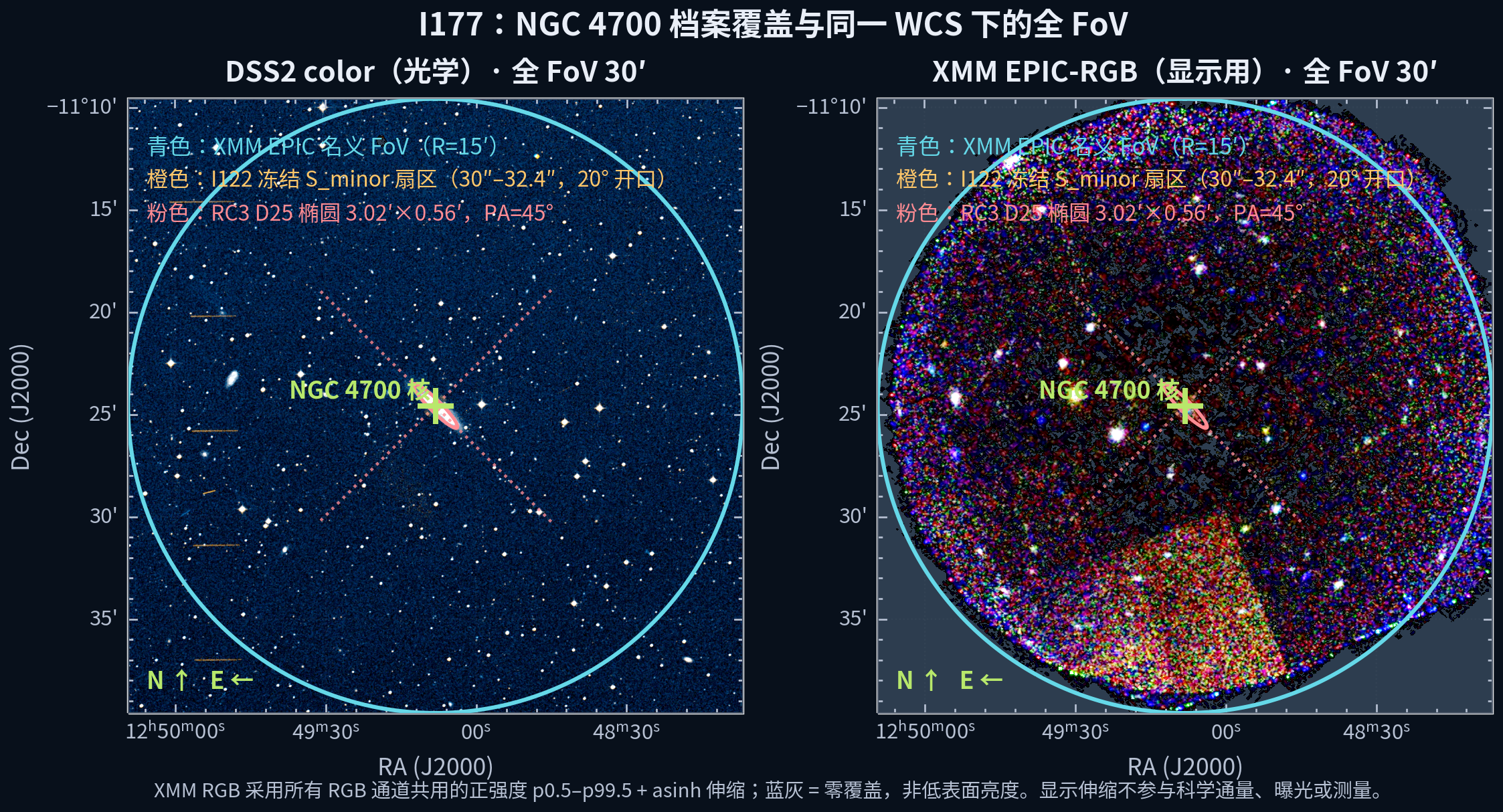
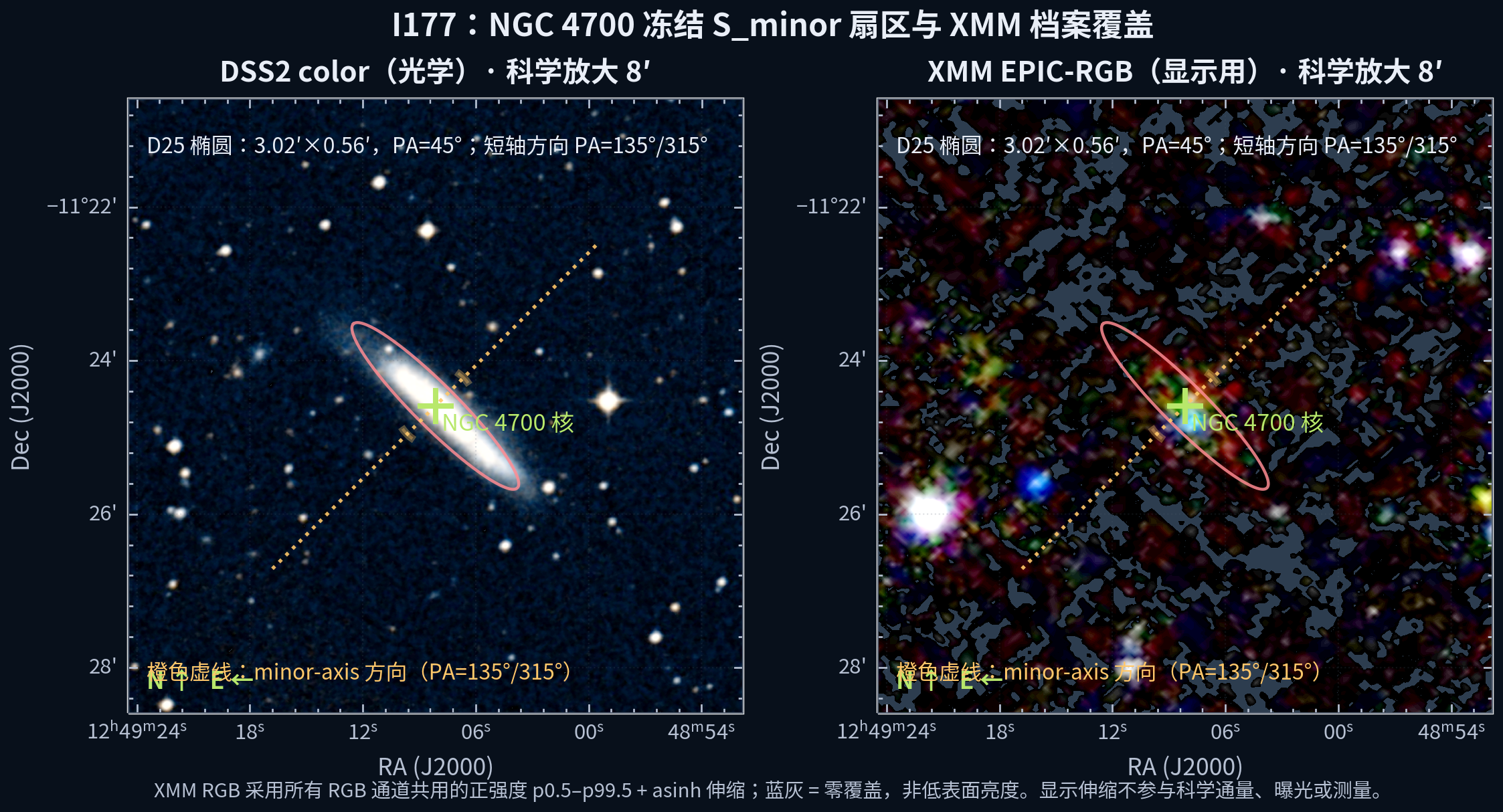
The XMM RGB uses a positive-intensity p0.5–p99.5 percentile clip shared across all channels and an asinh stretch; blue-grey marks zero coverage, not low surface brightness. This display stretch plays no role in exposure correction, scientific flux, or the Sigma_S − B measurement; the overlays use the original WCS.
04 · The number actually measured
Absolute surface brightness, not a contrast
Once qualified, the pre-frozen estimand is:
Sigma_S − Bwhere Sigma_S is the source-masked absolute 0.5–2.0 keV surface brightness within the S_minor sector, and B is the frozen, detector-qualified background model (QPB + CXB + SWCX + residual soft protons). Each EPIC camera is fit independently, using its own response.
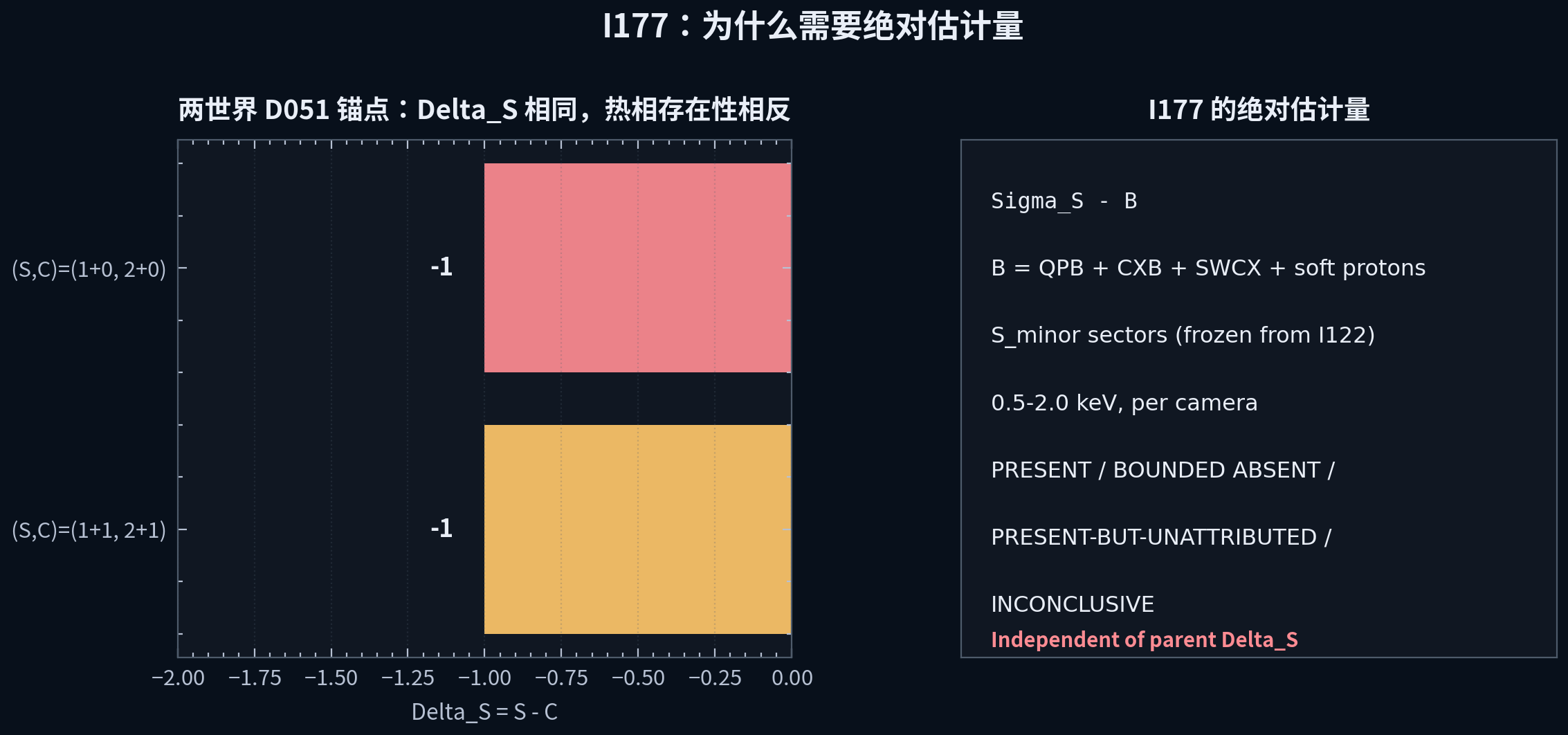
Delta_S gives the same value in the two worlds and cannot distinguish whether the hot phase exists. Right: I177's absolute estimand and its four possible outcomes. Download 1-column PNG · Download 2-column PNGFour possible outcomes:
- PRESENT: recovery-qualified positive
Sigma_S − B, exceeding the pre-registered material threshold; - BOUNDED ABSENT: recovery-qualified and the interval excludes the pre-registered material amplitude;
- PRESENT-BUT-UNATTRIBUTED: positive signal but not separable from unresolved point sources or AGN-associated emission;
- INCONCLUSIVE: the pre-declared detector/mask/background/response recovery qualification fails.
05 · If the answer comes out the other way, or cannot be answered at all
An honest BOUNDED ABSENT is informative; an unqualified null is not
- PRESENT: the warm–hot correspondence gains a quantitative anchor; NGC 4700 becomes a positive sample in a multi-target prevalence synthesis.
- BOUNDED ABSENT: at the achieved sensitivity, the absolute surface brightness falls below the pre-registered threshold. This constrains the universality of the warm–hot correspondence, but is not equivalent to "no hot halo" — the hot phase could be fainter, at a different temperature, or outside the aperture.
- PRESENT-BUT-UNATTRIBUTED: a positive signal exists but cannot be attributed; this is a physically plausible intermediate state for an edge-on starburst, not a failure.
- INCONCLUSIVE: if any of the detector support, background model, or response recovery fails, no physical conclusion is drawn. Such a null is boring and does not deserve to be dressed up with pretty graphics.
06 · Cost, and the cost still unknown
The single request of this page: first authorise one qualification HEAVY, not observing time
The next step R5 left for I177 is critique (the D023 panel is pending a REFRAME binding), but the Presenter's page asks the PI to consider whether it is worth first authorising one R6 HEAVY qualification run — before the D023 panel — to test whether I177-E4 (response-folded injection/recovery) can be closed.
"77.4 ks PN" is only scheduled duration, not clean exposure and not a sensitivity calculation. Actual clean time, detector support, post-mask area, background-model precision, and response recovery are all unknown. If this HEAVY qualification fails, the correct action is to stop at INCONCLUSIVE, not to package unknown cost into a proposal.
Actionable choice for the PI
Approve: approve only the R6 HEAVY qualification package above; it does not automatically approve an XMM time request, nor does it close I177-E1–E4.
Do not approve: stop here. This page has already stated that there is currently insufficient evidence to commit observing time or to claim hot-phase presence/absence.
Sources and reproducibility
Evidence boundary of this page
- Rossa et al. (2008), HST/ACS F658N imaging of NGC 4700, arXiv:0804.3819. arXiv
- Li et al. (2013), Chandra survey of 53 nearby highly inclined disc galaxies, MNRAS 428, 2085. arXiv
- Dahlem et al. (2005), HI observations of high-inclination spirals, A&A 432, 475. DOI
- Local traceable inputs: the I177 idea card, R5 adjudication, I122 R3 E2 operator contract (SHA-256
55e0dc5b…647cb5), NGC 4700 source card, and the frozen HiPS2FITS display inputs of this page. All hashes, commands, and replay paths are recorded in the publication manifest.